Last Updated on August 29, 2026 by Mihir Mohan Madhu
Yes, it can be “normal” for a 2 year old to not be talking yet. Some toddlers are simply late talkers, and many catch up with the right support. At the same time, not talking at age two is also a common reason to check in with a pediatrician and a speech-language pathologist, because it can be an early sign that a child needs extra help with speech, language, hearing, or social communication. In this post, I am going to walk you through what “normal” can look like at age two, what red flags to watch for, and what you can do at home right now to support communication in a gentle, practical way.
Is it normal for a 2 year old not to talk.
Let’s go ahead and start with the honest answer. It depends on what you mean by “not talk.” Some two year olds have zero spoken words. Some have a few words but do not combine them. Some talk at home but not in public. Some do not use words, but they communicate clearly in other ways, like gestures, pointing, leading you by the hand, or using sounds consistently.
So when parents ask this question, I usually want to clarify a few things first.
- Is your child using any words, even approximations like “ba” for ball?
- Is your child using gestures like pointing, waving, clapping, nodding, or shaking their head?
- Does your child understand simple directions like “get your shoes” or “come here?”
- Does your child try to get your attention and share interest, like showing you a toy or looking back and forth between you and something they want?
- Are there any concerns about hearing, frequent ear infections, or inconsistent responses to sound?
If your child is not using speech yet, but they are still communicating in meaningful ways, that is often a reassuring sign. If communication is very limited across the board, that is a stronger signal to seek an evaluation.
What should a 2 year old be saying.
Parents deserve clear expectations. Development varies, but most two-year-olds are moving toward using words to label, request, protest, and comment. They are also typically understanding far more than they can say.
One thing I will tell you is that speech and language are not the same thing. Speech is the physical production of sounds. Language is the system of meaning, like vocabulary, combining words, and understanding what others say. A toddler can have strong understanding and still be delayed in speech. A toddler can also have both receptive and expressive language delays.
If you are not sure where your child falls, that is exactly why screening and early evaluation exist. You do not need to wait until preschool to get support.
Quick clarity for parents.
If your 2 year old is not talking, it can still be within the range of typical development. It is also a common early sign that extra support is needed. The safest approach is to watch for communication attempts, understanding, and social connection, and to seek an evaluation sooner rather than later if you are unsure.
When should I worry if my 2 year old is not talking.
Now let’s move on to the part that is hard, but helpful. There are certain patterns that suggest “wait and see” is not the best plan. A child can be late to talk and still be developing beautifully, but we want to catch concerns early because early support can change the whole trajectory.
Red flags that are worth an evaluation.
Consider reaching out to your pediatrician and an SLP if you notice several of these:
- Your toddler has no words and very limited gestures.
- Your toddler does not seem to understand simple directions or familiar routines.
- Your toddler rarely points to show you something, or does not look back and forth between you and objects.
- Your toddler becomes extremely frustrated often, especially during everyday needs like snack time, play, or transitions.
- Your toddler lost words they used to say, or stopped using gestures they used to use.
- Your toddler does not play like other children- They do not use age-appropriate toys as intended, or they have a total lack of interest in toys all together.
- You suspect hearing issues, or your toddler has frequent ear infections.
If any of these are true, you are not doing anything wrong. You are noticing something important. That is good parenting.
What are common reasons a 2 year old is not talking.
There are many possible reasons. Some are simple. Some are layered. Some are temporary. Some need ongoing support. Here are a few common categories to discuss with a professional.
Hearing differences.
Even mild hearing loss can impact speech development. If a toddler cannot consistently hear speech sounds, it is much harder to learn to say them. This is why hearing tests are often one of the first steps when speech is delayed.
Late talking or late language emergence.
Some toddlers talk later than peers and still develop typical language over time. These children often show solid understanding, social interest, play skills, and use of gestures. They may benefit from speech therapy or parent coaching to help language “click” faster.
Speech sound difficulties, including motor speech challenges.
Some children know what they want to say but cannot coordinate the movements needed to produce clear speech. These children might use a lot of vowels, have inconsistent attempts, or seem to try hard to get words out.
Social influences and birth order.
Is your child the youngest in the family? Does your child have older sibling who like to “talk” for your two-year-old? If your toddler has very talkative siblings, they can have a hard time getting a word in. Remind older siblings to give your two-year-old an opportunity to speak.
Autism and social communication differences.
Some autistic toddlers talk later, and some develop speech on a different timeline. Communication can still grow in powerful ways, especially when families are supported early. If autism is part of your child’s profile, the goal is not just “talking.” The goal is reliable communication, connection, and self-advocacy.
Global developmental delays or learning differences.
Sometimes delayed talking is part of a broader pattern that includes motor development, cognitive development, or adaptive skills. This is where a developmental evaluation can be very helpful.
What to do if your 2 year old is not talking yet.
Now let’s get into the good stuff, which is what you can actually do next. Here is a simple, parent-friendly plan that works whether you are an SLP supporting families, or a parent trying to figure out your next step.
- Schedule a pediatrician visit and share your concerns clearly.
- Request a hearing evaluation, even if you think hearing is fine.
- Get a speech-language evaluation with a pediatric SLP.
- Ask about early intervention services in your area if you are in the United States.
- Start supportive communication strategies at home while you wait, because waitlists are real.
That is it. It does not have to be more complicated than that. You can always adjust the plan once you have more information.
At-home strategies that support language without pressure.
I want to share strategies that are actually doable. Not the kind that require you to turn your whole day into therapy. The goal is to increase communication opportunities, reduce frustration, and make it easier for your child to participate.
1. Follow your child’s lead in play.
When your child is interested, their brain is open. Sit on the floor. Copy what they do. Comment more than you question. If they roll a car, you roll a car and say “go.” If they stack blocks, you stack blocks and say “up.”
2. Model short, useful phrases.
Toddlers do not need long sentences to learn language. They need lots of repetitions of simple language tied to real life. Think one to three words. Say the same tiny phrases again and again in context.
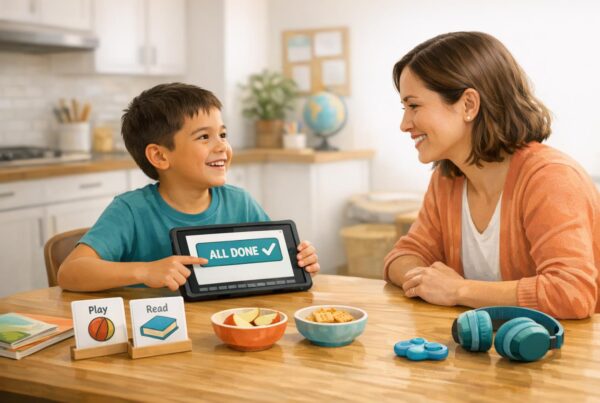
Examples. “More.” “Help.” “Go.” “All done.” “My turn.” “Open.” “Stop.”
3. Build in predictable communication routines.
Routines give toddlers chances to communicate. A routine might be bubbles, snack, bath, or a bedtime book. You do the same steps, the same words, and you pause at the same moments.
For example, with bubbles you can say “ready.” Pause. Then “go.” Blow bubbles. Then pause again and say “more.” This gives your child a natural moment to look, gesture, vocalize, or attempt a word.
4. Use visual supports and simple choice-making.
A two year old who is not talking still deserves a way to express preferences. You can offer two choices, hold them up, and wait. If they reach, point, or look, you label it.
You can also use simple pictures. A picture of milk. A picture of water. A picture of outside. This is a bridge to more robust communication systems when needed.
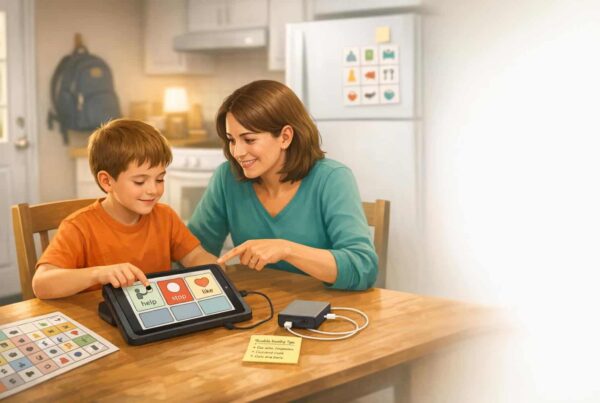
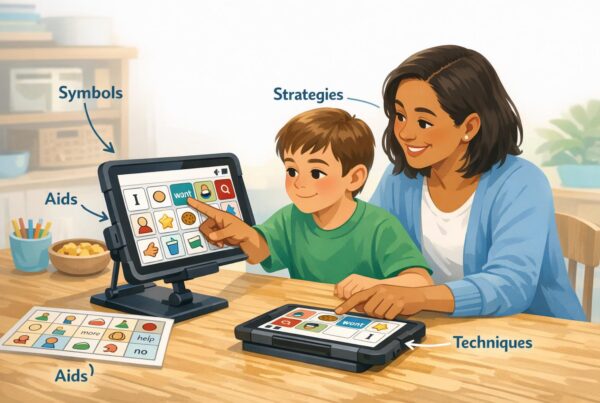
5. Consider AAC early, not as a last resort.
This is a big one, especially for families navigating autism or significant speech delays. AAC is not giving up on speech. AAC is giving your child a way to communicate right now.
AAC can include gestures, signs, picture boards, or a speech-generating device. The most important point is access. When children can communicate, frustration often decreases and connection often increases. Many clinicians emphasize that AAC works best when it is modeled naturally and consistently, with no pressure to perform .
Also, it helps to remember that communication is more than requesting. Kids deserve words for opinions, humor, and connection. A strong AAC approach includes core words that can be used everywhere, not only “wants and needs.”
What speech therapy might look like for a 2 year old who is not talking.
A lot of parents worry that speech therapy will be drill-based or stressful. For toddlers, good therapy often looks like play. It looks like routines, songs, books, toys, and coaching you in the moment.
Depending on your child’s profile, therapy might include:
- Teaching parents how to model language in daily routines.
- Supporting joint attention, turn-taking, and back-and-forth interaction.
- Building gesture use and functional communication.
- Introducing AAC, if needed, and teaching the whole family how to use it consistently .
If you are an SLP reading this, you already know that carryover is the whole game. It is not about one great session a week. It is about helping families build communication into real life.
A gentle mindset shift that helps parents breathe again.
If your toddler is not talking, it is easy to get stuck in the fear loop. You Google. You compare. You replay every milestone. I have seen this over and over again.
Here is the shift that helps.
Your job is not to predict the future. Your job is to respond to what your child is showing you today, and to get support when you need it.
And let’s be really clear. Communication progress is not only measured in spoken words. It is measured in things like initiating interaction, protesting safely, asking for help, commenting, and repairing misunderstandings. Those “small wins” build confidence and real-life communication strength over time .
Evidence-based resources you can trust.
I also want to point you to a few reputable starting points. These are not meant to replace an evaluation, but they can help you feel grounded and informed.
- CDC developmental milestones and early warning signs, as discussed at [https://www.cdc.gov/ncbddd/actearly/milestones/index.html](https://www.cdc.gov/ncbddd/actearly/milestones/index.html).
- American Speech-Language-Hearing Association guidance on communication development and when to seek help, available at [https://www.asha.org/public/speech/development/](https://www.asha.org/public/speech/development/).
- National Institute on Deafness and Other Communication Disorders information on speech and language developmental milestones, available at [https://www.nidcd.nih.gov/health/speech-and-language](https://www.nidcd.nih.gov/health/speech-and-language).
If you notice how these resources are written, they all come back to the same theme. Early identification and early support matter. You do not have to panic, but you also do not have to wait.
FAQs about a 2 year old not talking.
Is it normal for a 2 year old to not talk but understand everything?
It can happen. Some toddlers have strong receptive language and delayed expressive language. It is still a good idea to get an evaluation, because an SLP can help you understand whether your child’s speech delay is likely to resolve on its own or needs targeted support.
Should I wait until age 3 if my toddler is not talking?
In most cases, no. If you are worried at age two, it is reasonable to seek help now. Early intervention and early speech therapy can be very supportive, and you can always adjust the plan if your child makes rapid progress.
Can AAC stop my child from talking?
AAC is widely used as a communication support, and many clinicians emphasize modeling it without pressure and integrating it into real life . AAC is designed to increase communication access, not reduce it. If speech develops, AAC can still remain as a helpful tool in challenging moments.
What are simple things I can do at home today?
Start with play and routines. Use short phrases, repeat them often, and pause to give your child a chance to communicate in any form. Use choices and visuals. If frustration is high, focus on functional communication like “help,” “more,” “stop,” and “all done.”
What if my child seems frustrated and has tantrums because they cannot talk?
That is common. A big part of early communication support is giving your child a way to express needs and preferences, including refusals. Many AAC and early communication frameworks highlight that honoring safe refusals can reduce meltdowns and support regulation over time .
Closing thoughts.
If you came here wondering, “Is it normal for a 2 year old not to talk?” I want you to leave with two things. First, it can be within the range of typical development, especially if your toddler is communicating in other ways. Second, you never have to earn the right to ask for help. If your gut is telling you to look into it, listen to that.
Now that you understand the bigger picture, the next best step is simple. Talk with your pediatrician, schedule a hearing check, and reach out to a pediatric speech-language pathologist. Then, while you wait for appointments, keep communication light, playful, and consistent at home.
You are not behind. You are in motion. And that matters.