Last Updated on August 29, 2026 by Mihir Mohan Madhu
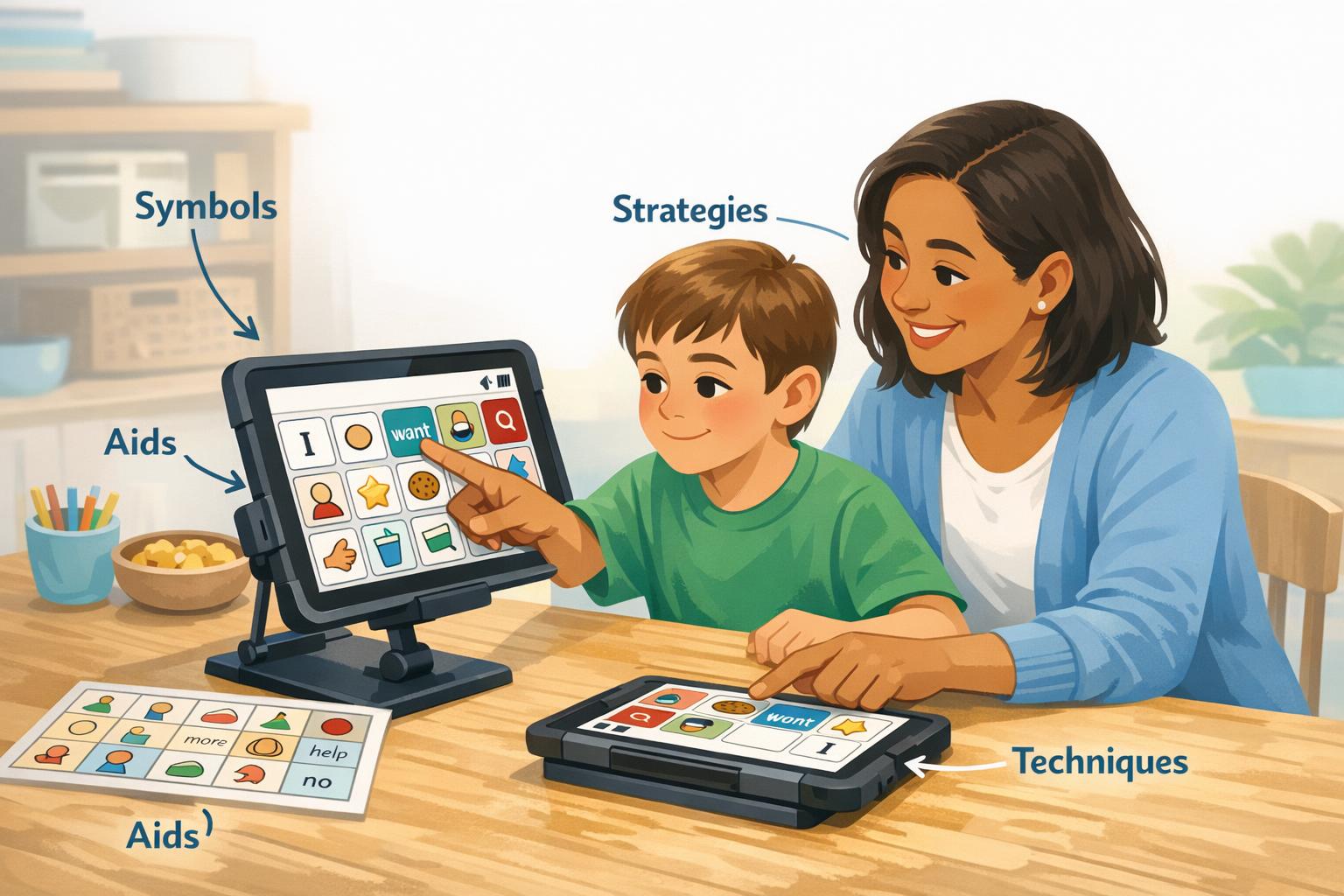
AAC interventions are therapy approaches that teach and support a person to communicate using Augmentative and Alternative Communication tools and strategies. AAC can include low-tech options like picture boards or communication books, and high-tech options like speech-generating devices or tablet apps. AAC interventions are not only about “getting a child to request.” They are designed to build real language for connection, learning, self-advocacy, and participation across daily life.
What does AAC mean, and what counts as an AAC intervention?
AAC stands for Augmentative and Alternative Communication. It includes any method, tool, or system that helps someone communicate when speech is not reliable, not available, or not efficient.
An AAC intervention is the intentional plan for how a child or adult will learn to use AAC. It includes how the team chooses a system, teaches communication skills, supports access, and builds consistent use across settings like home, school, and the community.
Who benefits from AAC interventions?
AAC interventions can support individuals with complex communication needs. This includes many children with autism, and also people with apraxia, cerebral palsy, Down syndrome, stroke, ALS, and other developmental or acquired conditions.
Why AAC interventions matter for autistic children and their families.
When a child cannot reliably say what they need, the world can feel unpredictable and frustrating. AAC interventions reduce that pressure by giving the child a consistent way to express wants, feelings, refusals, questions, and ideas. Over time, that communication access can support regulation and reduce the “guessing game” that so many families live in.
AAC also supports participation. It can help a child take part in routines, play, learning, literacy activities, and friendships, because they have a way to contribute.
Quick clarity for parents and SLPs.
AAC interventions are not a single device or a single program. They are a planned way of teaching communication that includes modeling, access, vocabulary, partner training, and daily practice in real routines.
Types of AAC used in AAC interventions.
AAC interventions may use one system or a combination of systems. Many successful plans include both high-tech and low-tech options, so communication is always available even if technology is unavailable.
- Low-tech AAC. Picture boards, communication books, printed core word boards, and picture exchange systems.
- High-tech AAC. Speech-generating devices, tablets with AAC apps, and dynamic display systems with folders and pages for vocabulary.
- Unaided AAC. Gestures and sign language, when appropriate and accessible for the communicator.
High-tech versus low-tech AAC, which is better?
This is a common question, and the most helpful answer is that both can be valuable. High-tech AAC can provide robust language and voice output. Low-tech AAC can be faster in some moments, easier in wet or messy environments, and essential as a backup. Many teams aim for a “belt and suspenders” approach, so communication never stops.
What AAC interventions actually look like in real life.
AAC interventions are most effective when they are woven into everyday routines, not limited to therapy drills. That means the child sees AAC used at snack time, during play, in the car, at school, and in the community.
AAC modeling, the cornerstone of many AAC interventions.
One of the most widely used strategies in AAC intervention is modeling, also called aided language input or aided language stimulation. Modeling means the adult uses the AAC system while speaking, so the child sees how communication works on their device or board.
For example, if you say, “We are going outside,” you also tap “go” and “outside” on the AAC system. Modeling is not a test, and it does not require the child to repeat it back.
Building language beyond requesting.
A modern AAC intervention should go beyond “cookie, iPad, more.” People who use AAC have jokes, opinions, questions, and stories, just like everyone else. Many teams prioritize core words because they are high-frequency and flexible across settings, such as “go,” “help,” “stop,” “want,” and “not.”
Core components of strong AAC interventions.
AAC interventions can vary, but the most effective plans usually share a few key elements. These are the “big rocks” that help prevent frustration and reduce device abandonment.
1. Reliable access and appropriate setup.
If the device is not within reach, charged, and easy to use, communication will not happen consistently. AAC interventions often include practical solutions like mounts, straps, and printed backups.
2. Personalized vocabulary that fits the communicator.
Engagement increases when vocabulary reflects the child’s real interests and relationships. This can include favorite activities, family names, preferred jokes, and school routines. Personalization is one of the fastest ways to increase buy-in.
3. Consistent practice inside daily routines.
Consistency usually beats intensity. AAC interventions work best when adults build small communication moments into the day, instead of relying on one long practice block.
4. Partner training for parents, teachers, and peers.
AAC is a team sport. When communication partners know how to model, pause, respond, and keep AAC available, the child has more opportunities to learn.
A step-by-step example of an AAC intervention plan you can start this week.
If you are a parent, you do not have to do everything at once. If you are an SLP, you do not have to fix every skill in one session. Here is a practical, simple framework that aligns with what we know helps AAC stick.
- Pick one routine. Choose a routine that happens daily, such as snack, bath time, or getting in the car.
- Choose 3 to 5 useful words. Include at least one core word like “more,” “help,” “go,” “stop,” or “all done.”
- Model without pressure. Use the AAC system as you talk, and do not require imitation.
- Create one reason to communicate. Pause, offer a choice, or “forget” a necessary item so the child has a meaningful reason to send a message.
- Respond like it matters. Treat AAC messages as real communication, because they are. Honor refusals when safe, and celebrate attempts.
How AAC interventions support literacy and learning.
AAC interventions are not separate from academics. They can directly support reading, writing, and classroom participation by giving students a way to answer questions, comment, retell stories, and build sentences.
Using AAC during reading.
In literacy routines, AAC can be used to pre-teach vocabulary, answer “wh” questions, and retell key events. This helps a non-speaking or minimally speaking student show comprehension and actively participate.
Using AAC for writing and self-expression.
AAC can also be a writing tool. With modeling and supportive activities like shared storytelling, journaling, and sentence starters, AAC users can generate real written output and share their ideas with an audience.
Common concerns about AAC interventions, answered with care.
“Is AAC a last resort?”
No. AAC is best understood as a language access tool. Many people benefit when AAC is introduced early and used confidently, instead of waiting for years of frustration.
“What if my child only uses AAC to ask for things?”
That is a normal starting point. Requesting is motivating and straightforward, and it is often an early “small win.”
Over time, strong AAC interventions intentionally expand communication functions. They teach commenting, refusing, asking questions, and sharing ideas using core words and modeled phrases.
“What if my child refuses the device?”
Resistance is usually data, not defiance. Common reasons include vocabulary that feels irrelevant, a system that is too complex, physical access challenges, or stigma. Interventions often improve success by simplifying layouts, personalizing content, and building fun, low-pressure practice into real life.
“What if there are mistakes or wrong buttons?”
Mistakes are part of communication. Many AAC learners build confidence when adults respond warmly and help repair breakdowns instead of correcting every error. Repair attempts like “help” or “try again” are actually advanced communication skills worth celebrating.
Evidence-informed guidance and trusted resources.
If you want to go deeper, here are a few highly trusted starting points for AAC information and clinical guidance.
The American Speech Language Hearing Association (ASHA) offers an overview of AAC and how SLPs approach assessment and intervention, as described in:
https://www.asha.org/njc/aac/?srsltid=AfmBOopYI3c_7tCdVwqbjCZiPT_vYMKr7U_10d8cLB5DZw-TsTKXZMGo
For a research-focused, accessible source on AAC and autism, Autism Speaks provides practical information on AAC options and how they support communication, as discussed in https://www.autismspeaks.org/technology-and-autism.
The NIH NIDCD also covers communication disorders and treatment approaches, including AAC-related supports, in https://www.nidcd.nih.gov/health/assistive-devices-people-hearing-voice-speech-or-language-disorders.
This can be a useful, medically grounded overview for caregivers.
FAQs about AAC interventions.
What are AAC interventions in speech therapy?
AAC interventions in speech therapy are structured plans that help a client communicate using AAC tools and strategies. They often include selecting a system, teaching vocabulary, modeling use, training communication partners, and supporting consistent use across settings.
What is the most important strategy in AAC intervention?
Modeling is one of the most important strategies. It means communication partners use the AAC system while they speak, showing the AAC user how to express real messages without pressure to perform.
Do AAC interventions stop a child from talking?
Many families worry about this. AAC is designed to support communication, not limit it. AAC can augment speech when speech is emerging and provide a reliable voice when speech is not available or is inconsistent.
How early can AAC interventions start?
AAC interventions can begin early. In practice, many teams introduce AAC in preschool years, especially when a child needs a consistent way to participate in routines and early learning activities.
What should we target first in AAC intervention for autism?
Many teams start with a small set of powerful core words, then expand to include personalized vocabulary that supports daily routines and the child’s interests. Early wins often include requesting, refusing, and getting attention, because these quickly show the child that communication works.
Closing thoughts for parents and SLPs.
AAC interventions are ultimately about dignity, access, and the basic human right of self expression. They give a child a reliable way to be understood, to learn, to say no, to be funny, to ask questions, and to belong. When AAC is modeled consistently, personalized thoughtfully, and used across real life, it stops being “a device” and becomes a voice that grows with the communicator.