Last Updated on August 29, 2026 by Mihir Mohan Madhu
The four components of AAC are symbols, aids, strategies, and techniques. Together, these four parts explain what AAC “is” in real life. AAC is not just a device or an app. It is a complete communication system that includes what the person uses to represent language, the tools that carry the message, the ways partners support communication, and the physical methods used to access and produce messages. When all four components work together, AAC becomes more natural, more reliable, and far more likely to be used across home, school, and the community.
What counts as AAC, and why do the “4 components” matter so much.
AAC stands for Augmentative and Alternative Communication. It includes any method, tool, or system that supports or replaces speech for people who cannot rely on spoken language consistently. AAC can be low-tech, like picture boards or communication books, or high-tech, like speech-generating devices and tablet-based apps.
For many autistic children, AAC can reduce frustration and increase connection, because it gives them a reliable way to express wants, needs, ideas, questions, and feelings. It also supports participation in learning. AAC can be used during story time, in writing activities, and in everyday routines, not only during speech therapy.
The reason the four components matter is simple. When AAC is treated like “just the device,” families and teams often end up with a system that looks good on paper but is hard to use in real life. A complete AAC plan considers all four components so the child can communicate across partners and environments, even when technology fails or emotions run high.
The big idea. AAC works best when we plan for the whole system. That means the symbols the child will use, the aids that will carry those symbols, the strategies that help communication happen naturally, and the techniques that make access physically possible and consistent.
Component 1. Symbols. The “language” part of AAC.
Symbols are how meaning is represented in an AAC system. This might be pictures, icons, line drawings, written words, letters, or even sign language. Symbols are the building blocks that allow a communicator say “more,” “stop,” “I think,” “help,” or tell a whole story.
What symbols can look like in real AAC systems.
Symbols can be:
- Picture symbols. These are common in many apps and communication boards, and can be great for emerging communicators.
- Photos. Useful for highly personal vocabulary like family members, pets, favorite foods, or specific places.
- Printed words. Many AAC users move toward text-based communication or use a combination of symbols plus text.
- Letters and spelling. This supports more flexible language, especially as literacy develops.
- Manual signs and gestures. These can be part of AAC and can travel everywhere, even when a device is not available.
Why symbol choice matters for autistic children.
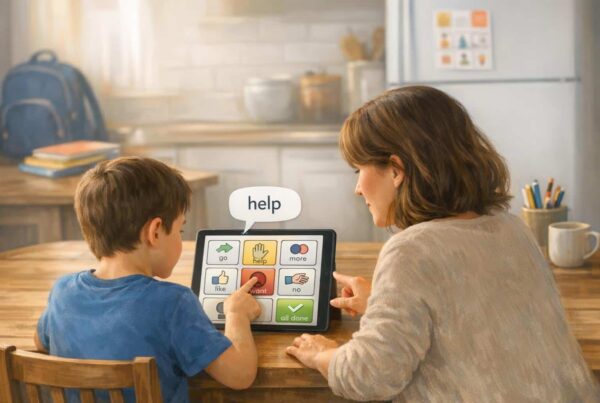
For autistic children, symbol systems need to support more than requesting. Traditional AAC sometimes over-focused on “wants and needs,” but modern AAC emphasizes real language using core words that work across settings. When symbols include core words like “go,” “help,” “not,” “want,” “like,” and “stop,” children can comment, ask questions, refuse, and connect socially.
This matters because communication is not only transactional. It is relational. When a child can say “that’s funny,” “I don’t like it,” or “uh oh,” you start to see confidence and personality come through, which builds more motivation to communicate.
Component 2. Aids. The “tool” part of AAC.
Aids are the physical or digital tools that help a person communicate. This is what many people think of first when they hear AAC. Aids include low-tech and high-tech options, and a strong AAC system often uses both.
Examples of AAC aids, from low-tech to high-tech.
AAC aids can include:
- Communication boards. Laminated or printed boards with symbols or words.
- Communication books. Organized pages that a child can flip through to find vocabulary.
- PECS style exchanges. Picture exchange can help some emerging communicators participate and initiate.
- Speech-generating devices. Dedicated devices that speak messages aloud.
- Tablet-based AAC apps. Apps that allow customization, vocabulary growth, and stored phrases.
Why “backup AAC” is part of the aids component.
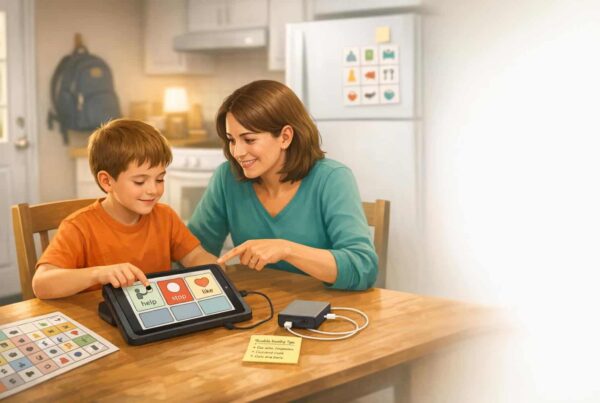
A practical AAC system plans for real life. Batteries die. Devices break. Pools, sandboxes, and bath time happen. One of the best ways to reduce AAC frustration and abandonment is to build in low-tech backups so communication does not disappear when technology is unavailable.
For SLPs and parents, this often looks like keeping a small printed core board in the kitchen, a copy in the car, and a travel version in a backpack. The goal is not perfection. The goal is access.
Choosing the “right” AAC aid is about access and ease.
The best AAC aid is the one the child can access reliably with minimal effort. That may mean larger buttons, fewer choices at first, or alternative access like eye gaze or switch scanning.
It also means the tool has to be available during real communication moments, like mealtimes, play, transitions, and reading. AAC cannot help if it is charging in another room.
Component 3. Strategies. The “how we support communication” part of AAC.
Strategies are the supports used by communication partners and the environment to make AAC successful. If aids are the tool, strategies are the plan for making the tool usable all day, not only in therapy.
AAC strategy that changes everything. Modeling.
One of the most effective AAC strategies is modeling, also called Aided Language Stimulation. This means adults use the AAC system themselves while they talk, without pressuring the child to perform. For example, if you say “more bubbles,” you also tap “more” on the device.
Modeling helps children learn that AAC is real language, not a test. It also reduces the demand that can shut down communication, especially for autistic children who are already working hard to process sensory input and social expectations.
Other practical strategies that help AAC stick.
Here are strategies that often support better carryover across home and school:
- Consistency across routines. Embed AAC in short, frequent moments across the day, instead of relying on long sessions.Motivation and personalization. Update vocabulary to match interests, inside jokes, and real life so the child has something worth saying.
- Permission to communicate “no.” Honoring refusals builds trust and reduces frustration over time.
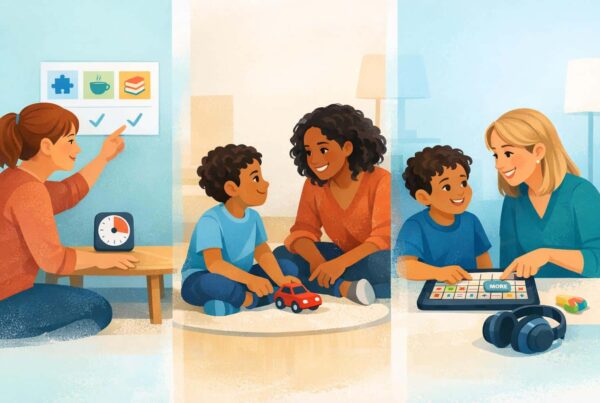
- Team training. When parents, teachers, and siblings understand the basics of the system, AAC becomes normal and expected, not “only for therapy.”
AAC strategies in action during reading and writing.
AAC strategies become especially powerful when used for literacy. When teams program story vocabulary and model AAC responses during reading, children can answer questions, retell events, and comment on the story.
AAC also supports writing development by making sentence-building possible, even when handwriting is difficult. Practical writing routines include shared storytelling, choice-based journaling, and interactive sentence strips where the child fills in a blank using AAC words.
Component 4. Techniques. The “how the person physically uses AAC” part.
Techniques describe how the AAC user physically accesses and produces messages. This includes the motor plan, the access method, and the way selections are made. Techniques are a big reason why a system that looks great in a demo can feel impossible for a child in real life.
Examples of AAC techniques.
AAC techniques can include:
- Direct selection. Pointing or tapping a symbol on a board or screen.
- Eye gaze. Looking at symbols to indicate a choice, often paired with partner-assisted scanning or eye-gaze technology.
- Switch access. Using switches to scan and select options.
- Partner-assisted scanning. A communication partner reads choices and the child signals yes or no to select. This is often used when direct touch is difficult.
Why technique is often the missing piece.
When a child struggles to use AAC, it is tempting to assume they are not ready, not motivated, or not understanding. Sometimes the real issue is technique. The buttons may be too small. The system may require too many steps. The child may need a mount, a keyguard, or a different access method.
This is one reason AAC teams often include an SLP and, when possible, an assistive
technology specialist. The goal is to make communication easier than giving up.
How the 4 components work together in real life, not just in theory.
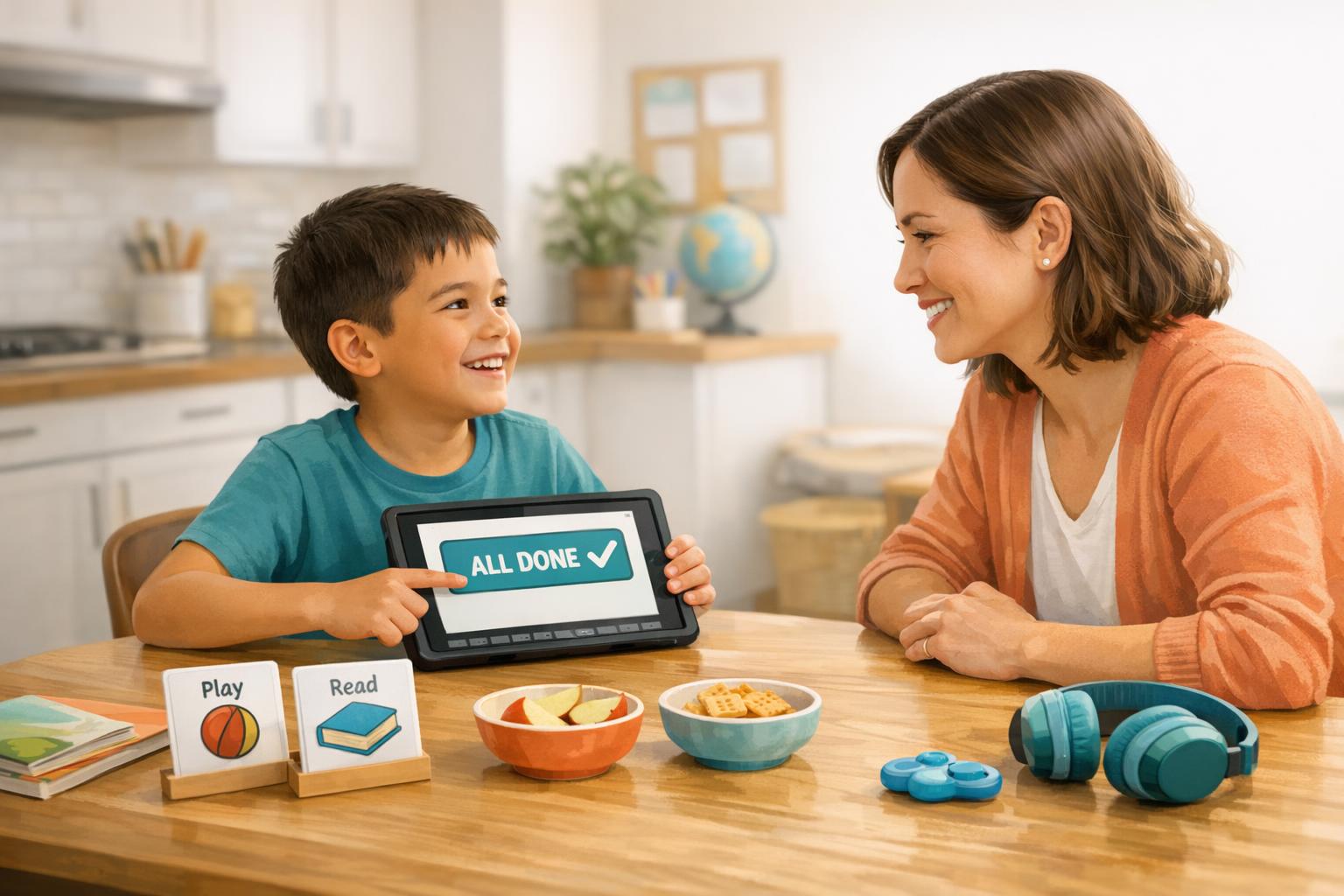
Here is a simple example that shows all four components working together for an autistic child during snack.
Scenario. A child wants crackers, but also wants to tell you they do not want the dip.
- Symbols. The system includes core words like “want,” “more,” “no,” and fringe words like “cracker,” “dip.”
- Aids. The child has a speech-generating device available at the table, plus a printed backup core board on the fridge.
- Strategies. You model “want cracker” on the device while you say it aloud, then pause without demanding imitation.
- Techniques. The child uses direct touch, with larger buttons and a stable device position so access is easy and consistent.
When these pieces align, communication becomes smoother. You see fewer breakdowns, more initiation, and more willingness to keep trying, even when a message is misunderstood.
Common mistakes I see when teams focus on only one component.
Mistake 1. Treating the aid as the whole AAC system.
It is understandable to think, “We got the device, we are done.” But without modeling, personalization, consistent access, and a technique the child can manage, the device often ends up unused. This is part of why device abandonment and low engagement happen.
Mistake 2. Over-focusing on requesting.
Requesting is important, but it is not the whole point of communication. When vocabulary includes core words and conversational language, children can build real interactions and self-advocacy.
Mistake 3. Not planning for the environment.
AAC needs to travel with the child. That includes transitions, community settings, school, and home routines. Making the system portable and creating reminders to bring it into daily life is a strategy that often makes or breaks success.
Mistake 4. Ignoring technique and access barriers.
If a child cannot physically access the system with ease, they will not use it consistently. This is not a motivation problem. It is a design problem, and it can often be improved with the right supports and adjustments.
A practical checklist for SLPs and parents. How to strengthen each AAC component this week.
If you want a starting point that feels doable, here are simple actions that match each component.
- Symbols. Add or highlight 5 to 10 core words that can be used across activities, like “go,” “stop,” “help,” “more,” “not,” “like.”
- Aids. Create one low-tech backup board and keep it somewhere visible, like the kitchen or the backpack.
- Strategies. Model one or two words on the AAC system during a routine you already do, like snack or bath time, with no pressure to respond.
- Techniques. Watch for signs of struggle. If the child is missing buttons or avoiding the device, consider changes like bigger buttons, a more stable mount, or a different access method.
Evidence-informed perspective. Why AAC is more than communication.
AAC supports participation. When children have consistent access to communication, they can join classroom conversations, demonstrate comprehension during reading, and take part in writing activities in ways that are recognized and valued.
For example, when AAC is integrated into literacy routines, teams can pre-teach vocabulary, model responses during reading, and use AAC for prediction, retell, and “WH” questions. These practices turn story time into a real communication opportunity, not a passive activity.
If you want to read more about how AAC can support literacy participation for nonverbal learners, the American Speech Language Hearing Association (ASHA) has a helpful overview of AAC and communication supports at https://www.asha.org/njc/aac/?srsltid=AfmBOorIhJVylO0n2y9FNKbQcXE8b90rbDUVg2r7xZSIPGKh-XPih9Mx.
It can also be helpful to explore the National Autism Center or evidence summaries on autism interventions and communication at https://www.nationalautismcenter.org/.
If you are looking for education law and access considerations, Wrights law offers parent-friendly special education resources at https://www.wrightslaw.com/.
FAQs about the 4 components of AAC.
What are the 4 components of AAC, in simple terms?
The four components of AAC are symbols, aids, strategies, and techniques. Symbols are the words or pictures. Aids are the tools like boards or devices. Strategies are how partners support communication, like modeling. Techniques are how the person physically uses AAC, like touch, eye gaze, or switches.
Is an AAC device the same thing as AAC?
No. A device is one AAC aid, but AAC also includes the symbol system, partner strategies like modeling, and the technique the child uses to access language. A device without the other pieces often leads to inconsistent use.
Can AAC include sign language or gestures?
Yes. AAC includes unaided communication like signs and gestures, as well as aided systems like boards and devices. Many children use a combination, especially in busy real-life moments.
Why is modeling such a big deal in AAC?
Modeling teaches AAC like a language. Adults use the system while speaking, showing the child how to find and combine words without requiring performance. This lowers pressure and increases learning opportunities across the day.
What if my child only uses AAC to request?
That is a common and valid starting point. To expand beyond requesting, prioritize core words and model comments, questions, refusals, and feelings so the child can experience AAC as real conversation, not only a way to get items.
Important note. This post is educational and not medical advice. Your child’s AAC system should be individualized with support from a licensed speech-language pathologist, and sometimes an assistive technology specialist, to match motor, sensory, and learning needs.